
Human Dignity
On the Perils of Indifference
By Nikos Kitsakis, June 2026
In the last couple of decades, mainly through software and services, more and more nudging of human behaviour took place. Everyone has noticed this on some level, but many of the people I talk to about this brush it off as nothing too important or even sinister, when it is, in fact, both.
The change for the worse came silently and in increments. But now – it seems to me – we are in the middle of quite a catastrophe already. We have created a world that is not as liveable as it should be (or as liveable as it was 30 years ago), because nobody paid attention.
Nothing less than our liberty and human dignity are at stake, or rather, under attack. Not just from outside enemies but from within. From people who, frankly, don’t have enough education and culture to know what makes life worth living. The kind of people who would do anything but open a good book and read it. Philistines, anti-intellectuals, and opportunistic businessmen.
I have alluded to the philistine nature of some people and what it leads to in terms of beauty in my last essay already. Here, however, I want to show that besides beauty, our human dignity is being taken from us.
When the Tool Shapes the Thought
In 2025, the BBC reported on smartphones that had been smuggled out of North Korea. The phones available there have only very limited functionality and are filled with spyware. The keyboard, for example, will monitor your inputs and change words that are deemed crimethink into state-approved expressions. If you type in “South Korea”, for instance, it will be changed to “Puppet State” and so on. You will also receive a warning, reminding you that you are not to use unauthorised terminology. In addition, the devices will also take a screenshot every couple of minutes in a file format that only the authorities can open. The phones reportedly can’t access the internet either – or at least nothing from outside the “Democratic People’s Republic of Korea”.
Since I can remember, North Korea has been held up in the West as an extreme example of a totalitarian surveillance state – and rightfully so. It would seem that in recent decades, however, we have created our very own flavour of authoritarianism. An authoritarianism which came creeping and is therefore, in its own way, almost more pernicious.
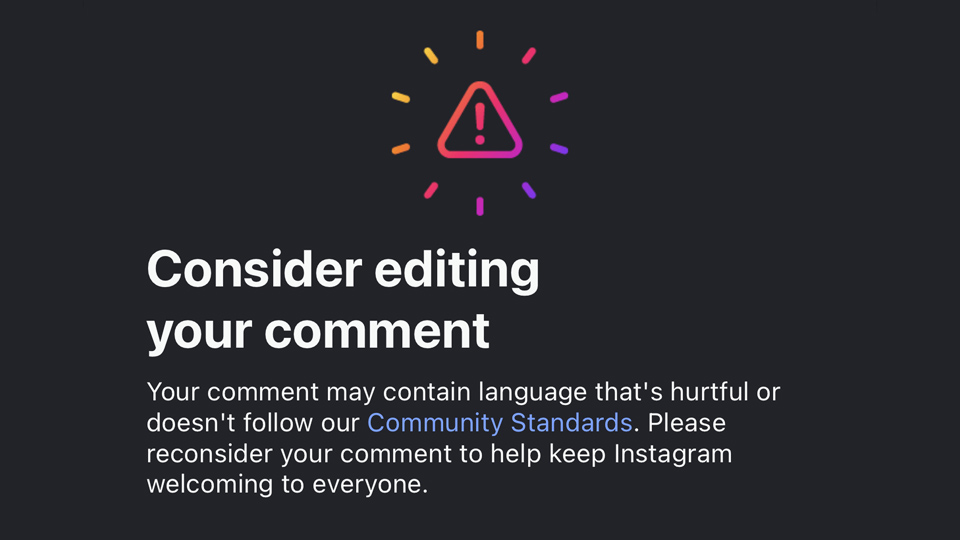
If you use Instagram, for example, and are just the tiniest bit outspoken when commenting on something, you will come across a warning that says “This caption looks similar to others that have been reported”, thus trying to dissuade you from using your particular choice of words. Another warning on the same platform says “Consider editing your comment” and goes on telling you that “Your comment may contain language that’s hurtful or doesn’t follow our Community Standards. Please reconsider your comment to help keep Instagram welcoming to everyone”.
I will do my own thinking, thank you very much.
The line about wanting to be “welcoming to everyone” reminds me of the Aristotelian aphorism that “a friend to all is a friend to none”¹. Being a friend (or welcoming) to everyone is, in other words, not only impossible but also undesirable and carries with it the repulsive stench of some artificial dystopia like Disney World, where everyone is always happy and nothing bad ever happens.
Now you might say that, unlike North Korea, social media platforms like Instagram are private companies and they have the right to make their own rules on their platforms. Of course they do. But to me, the imbalance between that fact on the one hand and the amount of users these platforms have on the other (the amount of influence on the psychology of whole societies they exert, in other words) is frightening.
Contemplate for a moment what it really means that your messages or comments are being read before you send them – even if just by a machine – and then either deemed good or bad. Do you see the disrespect that this reveals towards your intelligence and dignity? What it means in terms of moulding whole societies?
Read that warning again which says that “your comment may contain language that’s hurtful”. Hurtful to whom? For what reason? And did the people who wrote that warning consider for one minute that their words in that very warning message might hurt my feelings? Because I am indeed insulted when I think about how some socially inept geeks in Silicon Valley are taking it upon themselves to decide which type of language I may use.
Go Duck Yourself
Enforcing rules concerning language on social media might be bad enough, but even worse is having this Stasi technology built into the OS layer of your own device – the device you use for basically all your communication. Consider this passage from Nineteen Eighty-Four, where one of the characters talks about the Newspeak dictionary he is working on:
Do you know that Newspeak is the only language in the world whose vocabulary gets smaller every year? … Don’t you see that the whole aim of Newspeak is to narrow the range of thought? In the end we shall make thoughtcrime literally impossible, because there will be no words in which to express it. Every concept that can ever be needed will be expressed by exactly one word, with its meaning rigidly defined and all its subsidiary meanings rubbed out and forgotten. Already, in the Eleventh Edition, we’re not far from that point. But the process will still be continuing long after you and I are dead. Every year fewer and fewer words, and the range of consciousness always a little smaller. Even now, of course, there’s no reason or excuse for committing thoughtcrime. It’s merely a question of self-discipline, reality-control. But in the end there won’t be any need even for that. The Revolution will be complete when the language is perfect.
I don’t think that the engineers and project managers at Apple necessarily had any bad intentions when they designed their predictive text engine and auto-correct system in the way they did. But, assuming that they didn’t, they turned out to be so oblivious to common humanity that their product might just as well be called sinister. Maybe, if you ask them, they will even say that they had good intentions. To which I could only say that the road to hell is paved with good intentions.
Talking of hell, observe which words my phone thought would come next when I tried to write one of the most common idiomatic phrases which includes that word:

See no evil, hear no evil, write no evil: Click through the images to see a true spectacle of denying human reality unfold.
For a modern mechanism of word prediction to suggest “help” and “hello” in a sentence that starts with “There’s a special place in hel…” is beyond ridiculous. Your own results may vary, since all these systems learn (to a degree) from what the user has typed in the past, but I’ve seen far too many instances of this type of thing to believe that this is simply an error. Mind you that I chose this example very deliberately since “hell” is not even a swearword, unlike the infamous “fuck” which turns into a “duck” – a miscorrection that I also oppose on the same grounds of it being an insult to my intelligence.
Did the prediction system eventually stop me from writing “hell” in that instance? Of course not. Not yet at least. But the nudging of user behaviour, the denial of reality, and the paternalistic arrogance that this reveals is something I find deeply repulsive.
Lastly, you may want to contemplate that while the word prediction system will act like it doesn’t know words like “hell” or “fuck”, it will put a dotted red line under each of these words when they are misspelled (like “helll” or “fucck”), so it’s not a matter of them not being in the dictionary…
Genuine Stupidity
You can see this and similar patterns repeat almost everywhere in the tech world and its products nowadays. The newest member of this club is of course “Artificial Intelligence”, or what I call the “catalyst for an intellectual race to the bottom in the form of software” (admittedly a bit of a mouthful, but appropriate I think).
I have said in the past that, while mostly pretty stupid and without reasoning skills, LLMs are undeniably useful in some areas. Transcribing text from images, for example, is something that works fairly well. One should hope so, since pattern matching and language are at the core of the technology. LLMs are, however, also full of the political and social biases of their creators, and it shows.
It did show, for example, when one day I wanted to render into text some Soviet-era jokes that were declassified by the CIA (no, I’m not joking) but which they had digitised as images². ChatGPT stopped doing the job shortly after having started with the transcript. See for yourself:

The Soviet-era joke as in the PDF by the CIA and what ChatGPT did with it.
The irony of this behaviour by ChatGPT cannot have been lost on my readers, given what a nightmare the Soviet Union was in terms of freedom of expression. Apparently, the act of shooting someone is what is offensive to the software here because, as is always the case with AI, the technology has no sense for context and no capability for reasoning or understanding. In itself, this episode wouldn’t mean much. But consider for a moment the hundreds of millions of prompts that these AI systems handle each day and then try to extrapolate in your head what this means for our societies. A bit of nudging here, a bit of refusal there… All with good intentions. We’re just looking out for you, mate!
The Nudging Works
It is indeed noticeable how people express themselves differently on their social media these days. There is now a very visible trend of preemptive self-censorship and that is, of course, the death of free self-expression. When people think twice, hold back or soften what they say or write, then what does that say about how they think? Look at the two examples below:

Welcome to hell if you think that preemptive self-censorship is a good thing.
From the first example we learn that “died” is now apparently a bad word. People will censor it out of their own posts for fear of those being hidden by the algorithm. That’s also the reason why you’re hearing the word “unalived” more and more often when independent media types post about murder or suicide. Mind you that you will not actually find any official blacklists with words like “death” or “shoot” in the rulebooks of the social media platforms. And yet, people are avoiding them and others. Wherever posts with those words really get less reach is hard to tell, but I wouldn’t be surprised at all if places like Facebook or Instagram actually enforce something like this without telling anyone. But this is besides the point. The sheer possibility of it happening is apparently enough to make people start policing their own language and, more fundamentally, their own thoughts.
While both examples above concern me intellectually, the second one actually makes me feel sad on top: I had the censored image on the left show up on Instagram in an ad for a book of Jugendstil art. The image on the right is the original that I found in an online archive. Are there really people who are offended by a 120-year-old black-and-white drawing of an exposed woman’s breast in a work of art? The myopic puritanism on display here is the antithesis of having, much less celebrating, culture.
Self-Respect
There are some places where people will give up freely what little they have left of human dignity and self-respect. One of these I like to call “the place where ideas go to die” and it is, of course, LinkedIn.
Running my own business, I can see (to an extent) the advantages of such a platform. I post a series of typography tips there myself and one can make the point that LinkedIn is not completely without merit. But the platform also seems to elicit in some people the ugliest kind of self-promotional instincts, which leads them to engage in a sort of intellectual prostitution, as evident by a never-ending stream of platitudes and fabricated feel-good-stories of the lowest order. Take a look at this heart-warming and educational story by a female manager which, I am sure, must be 100% true:
I recently got engaged on top of a mountain in Austria.
The most asked question since has been: “Did you see it coming?”
The truth is… I didn’t see it coming. I felt it. A gut instinct. A deep knowing.
That same intuition plays a powerful role in leadership.
After this remarkably elegant pivot from personal anecdote to business matters, our manager then goes on to explain about hiring decisions and continues with the usual, and completely interchangeable, corporate slop that will leave you dumber for having read it. It’s a pity really, for if she had changed just one word in her text, her LinkedIn post could have been a work of art:
I recently got diarrhea on top of a mountain in Austria.
The most asked question since has been: “Did you see it coming?”
The truth is… I didn’t see it coming. I felt it. A gut instinct. A deep knowing.
That same intuition plays a powerful role in leadership.
A gut instinct it would have been indeed. Mind you that I am not condemning anyone for self-promotion. That is fair enough. If you’re capable of something, you should talk about it. But mindless engagement-bait that is posted simply because it’s considered “good for the algorithm” is not what anyone wants to sift through. How on earth, I would ask that person, do you think you are going to build a reputation by publishing nonsense like this? So the algorithm might pick up your post and show it to 50,000 people. So what? If your posting is a soulless platitude or obviously made-up, you just showed 50’000 people that you shouldn’t be trusted.
The Glassholes
Around 13 years ago, Google released Google Glass: A spectacle frame with a camera and a heads-up display on one side, which made you look like you had never had (or wanted) sex in your life. After it came out, the usual geeks were eager to buy and wear it all the time and everywhere. Since the people who get excited for this sort of thing are usually not very attuned to social norms – or one might say to humanity – it didn’t take long for them to run into trouble. After all, the built-in camera always points to what the user is looking at.

The perfect contraceptive: Google Glass. Image from Wikipedia

A restaurant owner in New York named Brian Ghaw, who had kicked someone out for wearing this beastly device and had established a no-smart-glasses policy, got to the heart of the matter in a New York Post piece, where he was quoted as saying “If someone were sitting at a table with their smartphone constantly pointing in a certain direction and you didn’t know what they were doing with it, you’d feel pretty uncomfortable as well”.
I’m glad for this and similar reactions which ultimately led to the term “Glassholes” being coined to describe the users of this device. It is one thing to make yourself look like a fool by wearing something so idiotic and ugly on your face, but quite another to step outside your house and constantly have a camera pointing at everything you look at. Because, apart from you being totally obnoxious, who in their right mind would trust a company like Google to not grab a picture here and there to “help ensure that your product is reliable, secure and operating normally”?
Second Attempt
Thankfully, Google Glass is no more. But today, another extremely trustworthy company, Meta, is selling a similar product: The Ray-Ban Meta glasses. They have two cameras instead of just one in order to make the wearer twice as insufferable.

It’s interesting – albeit completely unsurprising – that in all the press images that Meta has released of the glasses (where people are wearing them at least), the cameras almost vanish either because of the light or the angle the picture was taken at.
I find this new attempt to introduce spying devices into the general public revolting. And of course it comes from the company that was famously founded by a dork so antisocial and unlikeable that he had to resort to a technical solution to connect with other people.
Let me make it very clear that if you ever meet me with this garbage sticking from your face, I will ask you exactly one time to remove it. If you don’t, I will tear it from you, throw it on the ground and step on it for good measure. I’m not kidding. Not only are you an embarrassment to our species, you also very obviously don’t care about the privacy and dignity of other people. What happened to the concept of shame? What happened to common courtesy?
Then there’s another thing: Apart from any ethical considerations, if you just look at these glasses as a product, what problem are they supposed to solve? It’s not like people aren’t already distracted enough by their phones.
On Meta’s product website for this nonsense there’s a film that runs in a loop. In it, we see, amongst other things, a woman standing in front of a painting, looking at it through the glasses and zooming in. The message seems to be that paintings are boring, of course, but zooming in is fun! Superimposed on that film is the main slogan for the product: “AI glasses for effortless connection”. So Meta tries to wedge a layer of technology between yourself and what is right in front of you to make “connecting” more effortless?
Further down the page, there’s a picture promoting the hands-free calling feature showing a man wearing the glasses. Attached to the man is a speech bubble that reads “Hey Meta, call Max on WhatsApp”. Now isn’t that nice? A sentence with six words that includes two brand names! This is what the future of “effortless connection” apparently looks like. Make sure the dumb customer repeats our brand names often! Make it second nature! Make him be grateful for this age of effortless connection!
Beyond Awkward
How utterly removed the people in Silicon Valley are from understanding what makes us human is best demonstrated by a press image from Apple:

“Remove the stupid headset? But darling, I’m not wearing any headset!”
The so-called Apple Vision Pro in the picture above is – depending on your sense of reality – either a revolutionary headset that’s going to change the history of computing or a pair of overpriced ski goggles with screens in them. The use case is certainly a different one from the Meta glasses in that the idea here is a fully immersive experience. I find it ironic that, from the perspective of human dignity and self-respect, Meta actually did a better job with their glasses than Apple. But that concerns only the way in which the device will make the user look to the outside world: Apple’s ski goggles also have cameras that always point in the direction that the user is looking and are thus introducing the same ethical problem into the world as the Meta glasses.
Luckily for everyone who still retains a sense of dignity, the Apple Vision Pro seems to be quite a flop. Something I (and everyone with a brain) could have told the people at Apple from just looking at a preliminary sketch of the device before it ever entered a second design stage.
This is what I meant above, when I talked about how removed from reality the people in Silicon Valley really are. It must be an incredible bubble to live in. A completely homogenous and parochial environment where everybody thinks the same, no one has ever read any sophisticated literature or history, and no one ever said “no” to anything.
I have to say it again: Any sane person could have told the people at Apple that no one would isolate themselves willingly from other human beings by wearing ski goggles indoors. Especially not when they make you look like a halfwitted lunatic. That consideration alone should have stopped the development of this device in its tracks. It doesn’t matter how good the technology is that they developed for it. I have little doubt that it is quite impressive indeed. But to develop technology that is in search of a problem is not the way you create any kind of good product.
I will grant that a device like the Apple ski goggles might have some niche applications – its defenders will certainly argue that. Wearing them must indeed be interesting for five minutes while you’re at a demo or trade show. Some edge cases in architectural visualisation and similarly specific scenarios might benefit from a technology like this some of the time. But again: No one wants to look like a dork by wearing this sort of thing outside of very task- and time-restricted business scenarios.
Apart from all the concerns about your self-respect and the ethical dimension regarding the cameras, Apple’s ugly thing weighs about a metric ton, costs an absurd amount of money, induces headaches and motion sickness in many people, and runs on a battery which is external and connected through a cable. The last time I saw an external battery for a portable computing device was in 1989 when I got the original Game Boy – and there it was an optional accessory. For the Apple ski goggles the external battery is mandatory!
Oh Snap!
I hadn’t planned to spend this much time on writing about the idiotic AR/VR/AI glasses but the issue has forced itself upon me. As I said above, I find it deeply disturbing that the most unlikeable people of the most hated companies on the planet try to introduce what amounts to surveillance equipment into the world. The whole affair is not without an amusing side, though. Just look at this screenshot from a CNBC interview with Evan Spiegel, the CEO of Snap Inc., who is wearing his newly released AR-glasses:

I might frame this and hang it over my toilet. From CNBC on YouTube.
As if just this one image wasn’t funny enough, Spiegel then provides us with the most insidious corporate ejaculations that I’ve heard in a long time. The woman who interviews him asks:
Evan, thanks for joining us here today. You’re wearing your new “specs” which you just unveiled. They cost $2,195. The stock’s down more than 5%. How do you address investor concerns about the potential market for these?
To which our CEO replies:
It’s been such an exciting day for the company and something we’ve been working towards for more than 12 years now to really bring computing into the world and make it more human. And I think it’s something that people are really looking for in this moment where they feel like screens are distracting them. People are spending, on average, more than seven hours a day staring down at screens instead of connecting with their friends and staying present in the world. And we think specs offer a totally new opportunity to bring computing into the world around you and help computing feel more human and more personal.
Astonishing, isn’t it? Not only did this charlatan completely fail to answer the journalist’s question, he also made a statement which is the complete antithesis of what his product is all about. Make computing “more human”? He mentioned that exact phrase twice. One might be tempted to think, therefore, that he knows exactly how evil and inhumane his product and its implications really are. After all, the creators of the aforementioned “Democratic People’s Republic of Korea” also believed it necessary to include the word “Democratic” in the name, exactly because they wanted to legitimise their despotic project.
Researching and writing these essays takes a lot of time. So if you enjoy them, consider supporting this work with a small donation.
Support!Be that as it may, nobody has asked for smart glasses from Snapchat and nobody, I predict, will buy them. And on the subject of buying them: For what these glasses cost, I can organise quite a few dinner parties where I see my friends without any digital distractions. I might – at most – wear regular glasses that correct my vision, not cameras that send the biometric profile of my friend’s faces or what they said to the servers of fucking Snapchat.
Artificial History
There are a lot more things that I could talk about when it comes to what human dignity means in our time. So many indeed that this will surely not be my last essay about this topic. Let me close now however by once more talking about Genuine Stupidity (or Artificial intelligence, if you prefer), the use of which really does make people more stupid.
I was very disappointed when I saw an article some time ago on a website that promotes Greek culture. It showed – or rather claimed to show – a list of items that were supposed to exemplify ancient Greece and its achievements. Leaving aside the fact that it was very badly written and researched even worse, the article featured an AI generated picture for each item on the list.
AI-generated images that are made to resemble an existing object (or person) are a bad idea in most cases anyway. It becomes especially pernicious, however, when what is simulated is an item of our historical record. Everyone who ever worked as an archaeological illustrator can tell you that it is of utmost importance to get all the details right when drawing something for an archive or for publication. And then, of course, there is always photography as well. So why use AI-images in the first place? In this particular case, it could hardly have been a licensing issue, for the items in the article all have pictures that are freely available, either from Wikipedia or other sources. I should know, I took some of them.
Compare the AI-images from that article (on the grey background) with the originals³ that follow immediately after. They are the Mask of Agamemnon, the Artemision Bronze, and the Antikythera Mechanism:

If you care so little about Greek culture that you use AI-images instead of real photography to showcase it, why bother to write an article in the first place?
For whoever was responsible for that article to have been so lazy or so delusional is quite disheartening. The whole idea of promoting culture, especially Greek culture which is the root of everything that surrounds us, is to give people a sense of meaning and their history. To then blindly and stupidly use AI-images is akin to trying to promote good cooking while you serve your guests roadkill.
To their credit, the publishers had changed the images to real ones after what was probably a few weeks and now the piece seems to be gone altogether. For this to have happened in the first place is, to me at least, still quite incredible. The practice as a whole, on the other hand, seems to be alive and well. If it continues, we will rather sooner than later drown in slop.
I can tell you one thing for sure: The crisis of meaning that we are suffering through in the West right now is not going to be solved by losing faith in ourselves and our self-worth. We should therefore not walk around with stupid looking and overpriced pieces of spyware on our heads, self-censor when we want to express ourselves, or accept the erosion of truth through third-rate slop articles and social media posts which are flooding our digital spaces.
If you want to be able to look in the mirror tomorrow, you are going to have to stand up to this nonsense, today.
- Aristotle never actually said this in so many words but what he wrote in his Nicomachean Ethics amounts to pretty much the same thing. ↑
- One of my favourite jokes from that time was missing in the CIA file: An American dog, a Polish dog, and a Soviet dog sit together. The American dog says “In my country, if you bark long enough, you will be heard and given some meat”. The Polish dog replies “What is ‘meat’?” The Soviet dog says “What is ‘bark’?” ↑
- I took the pictures of the Mask of Agamemnon and the Artemision Bronze. In the former, however, I had to replace the background: The original is a linen which looks just like this, but the light and overall conditions were pretty bad. The picture of the Antikythera Mechanism is from the digital archive hosted by New York University and is available there in a special format. ↑
Share this article on Twitter/X!